


Susanna McLeod
Special to Canadian and Design Construction Report
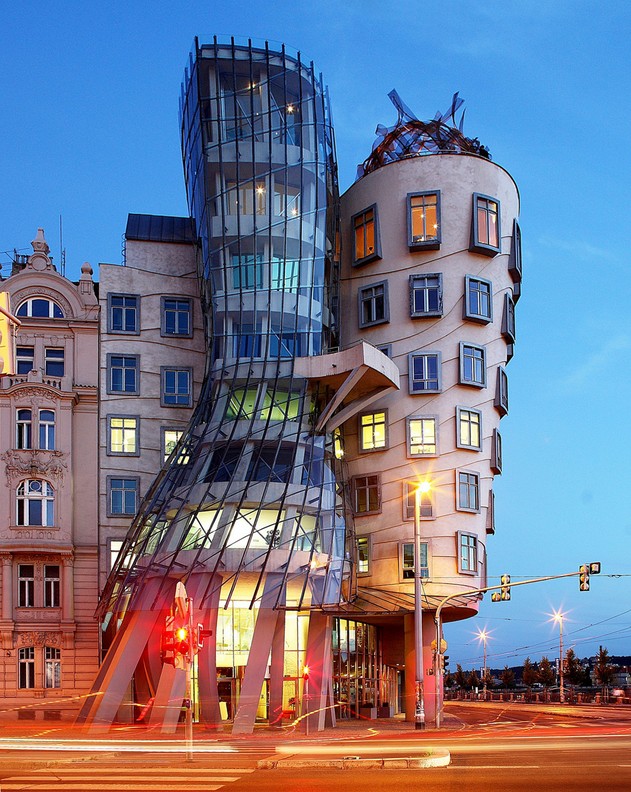
Traditional architecture may have gables, corbels, and perhaps cresting. Frank Gehry would have none of it. Standard façades and rooflines were out, mind-bending curves, twists, and how-does-he-do-it style were the Canadian-born architect’s forte, earning world recognition.
Dramatic sculptural art emerged from Gehry’s architectural designs, using metal, wire, fencing, and non-traditional materials. His buildings don’t just murmur, they shout for attention. The architect’s story began in Toronto, Ontario when Frank Owen Goldberg was born on February 28, 1929, to Jewish parents with Polish heritage. At the urging of his first wife, Anita Snyder, he changed his surname to Gehry in 1954 as a buffer against antisemitism. (He later regretted it.) Spending time at his grandparents’ hardware store, Gehry “learned about tools and building materials—wood, glass, metal, fencing—and loved to explore their functions,” said Caroline Evensen Lazo in Frank Gehry (Twenty-first Century Books, 2008).
The boy developed a passion for fish and fish art from his grandmother, who prepared and cooked gefilte fish weekly. Gehry visited art museums with his mother, and although his father was artistic, he did not encourage his son. Calling young Gehry “a dreamer,” the father “thought his son wouldn’t amount to anything,” Lazo mentioned. The family moved to California in 1947 when Gehry was 18 years old, just in time for the teenager to determine his career path.
Working as delivery driver, Gehry also attended classes at Los Angeles City College. “He took his first architecture courses on a hunch, and became enthralled with the possibilities of the art,” according to “Frank Gehry’s Biography—Academy of Achievement,” 2025. Realizing he required draftsman skills, the teenager “won scholarships to the University of Southern California and graduated with a degree in architecture,” in 1954. Completing a year of military service, Gehry next briefly studied city planning at Harvard in 1956. Disappointed with the curriculum, he left the program early.
Working with smaller, unsatisfying contracts, in 1962, the architect set up Gehry & Associates in Los Angeles. Feeling unaccepted by the local architectural community, Gehry found appreciation among artists and creatives. They taught Gehry “lessons of canny transformation, the ‘funk art’ aesthetic, how to expand a pair of binoculars to the scale of a whole building,” said Charles Jencks and Oliver Wainwright in “Frank Gehry Obituary,” The Guardian, December 6, 2025. (The Binocular Building is in Venice, California.) Gaining more techniques, the architect “was on to something interesting, a position outside normal architecture that was almost art, almost sculpture… .”
Commissions and acceptance were long in coming, but Gehry’s work caught on by the 1980s. His experimental architecture, with huge slabs of crumpled metal, curved and wrinkled glass, and fish (a lot of fish), ignited attention from across the globe. Critics called him mad, others saw value.
Hand-drawing his designs, Gehry made models with wood, foam, paper, glue, tape, and other materials. Ahead of the curve, the architect’s staff used CATIA (an aerospace computer-aided three-dimensional interactive application) to design the complexities of his buildings. Hiring computer programmers, he established Gehry Technologies to develop an innovative 3-D computer program, BIM (Building Information Modelling) to simplify planning, design, and construction of buildings.
Attitudes changed toward the innovative architect. After winning the coveted Pritzker Architecture Prize in 1991, Gehry’s awe-inspiring masterstroke in design came in 1997 with Spain’s Guggenheim Museum Bilbao. The museum is an exhibit itself, with striking exterior and amazing interior, where “rectangular spaces lead into circular galleries with curving walls,” said Lazo. The vast atrium with a skylight “is spanned by concrete, steel, titanium, elevator shafts… a total rhythmic composition.”
The museum skyrocketed Gehry to fame. Commissions arrived for his unique architecture, many in the United States, and a number in Europe and Asia. Accomplishments such as Gehry Tower in Hanover, Germany (2001), Walt Disney Concert Hall in Los Angeles (2003), Stata Center in Cambridge, MA (2004), and several more feature Gehry’s signature style. Canada was not left out.
Completing his first Canadian project in 2008, the Art Gallery of Ontario (AGO) was transformed by Gehry’s engaging vision. Featuring “sculptural staircases, the warmth of Douglas fir, and the extensive use of glass which infuses the galleries with natural light,” according to AGO in “Frank Gehry in Conversation,” December 3, 2016. Gehry’s Forma Towers in Toronto are currently under construction.
The inimitable Gehry is one of the rare architects “to be both respected by critics as a creative, cutting-edge force and embraced by the general public as a popular figure,” stated AGO. The architect earned a wheelbarrow load of awards and honorary degrees. At age 96, Frank Gehry died on December 5, 2025 in Santa Monica, California. He is survived by second wife, Berta Aguilera, three children (another daughter died in 2008), and two grandchildren. Frank Gehry was at last accepted, and reached the pinnacle of his architectural world. END 800 words
Susanna is a Kingston-based writer specializing in Canadian history.
Sources:
“Frank Gehry’s Biography—Academy of Achievement” 2025. https://achievement.org/achiever/frank-gehry/#biography
“Frank Gehry in Conversation,” Art Gallery of Ontario, December 3, 2016. https://ago.ca/events/frank-gehry-conversation#:~:text=The%20AGO%20is%20Toronto%2Dborn,connection%20between%20art%20and%20architecture.
Jencks, Charles; Wainwright, Oliver. “Frank Gehry Obituary,” The Guardian, December 6, 2025. https://www.theguardian.com/artanddesign/2025/dec/06/frank-gehry-obituary
Lazo, Caroline Evensen. Frank Gehry, Twenty-first Century Books, 2008.
https://archive.org/details/frankgehry0000lazo/page/n3/mode/2up
“Obituary: Frank O. Gehry,” Society of Architectural Historians. https://sah.org/2025/12/10/obituary-frank-o-gehry-1929-2025/

