


By Susanna McLeod
Special to Canadian Design and Construction Report
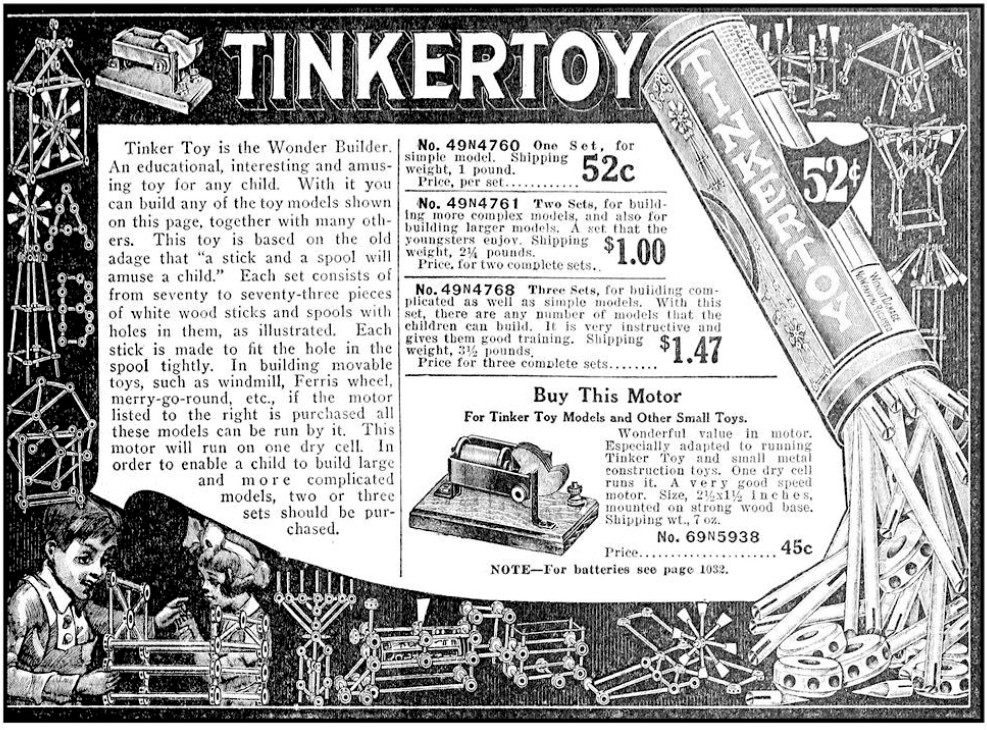
“I build a thousand wondrous things that teach both girl and boy; I teach content and happiness; my name is Tinkertoy.” The toy’s slogan was long, yet an invitation to the possibilities of fun. Charles Pajeau of Evanston, Illinois was discontented with his career and he turned to invention. Introduced in 1914, Tinkertoy™ immediately engaged kids in architecture, geometry, and construction. It remains a constant for hands-on learning.
Working in the family tombstone manufacturing operation, Pajeau (born about 1875) despised working in the monuments business. Searching for a better career fit, he set about inventing a range of gadgets. Observing children happily playing with household pencils, sticks, and bare thread spools, Pajeau made a wooden set of rods and spools with centre holes, a toy to stimulate children’s creative imaginations.
“Pajeau based his design on the Pythagorean theory,” wrote Patrician Hogan in “100 Years of Tinkering” (Strong National Museum of Play). In 1914, he made precision parts, producing “his wooden sticks the correct length to form the 90-degree triangles that strengthened the towers, windmills, and houses kids built.” Pajeau dubbed his invention “Thousand Wonder Toy.”
Commuting daily by train from Evanston to Chicago for work, the inventor discussed his toy invention with fellow passenger Robert Pettit in 1913. The young man was a trader with Chicago Board of Trade and was also seeking relief from the grind of his job. And he had funds to launch the project. Pajeau and Pettit formed a partnership, called The Toy Tinkers of Evanston, Illinois.
Filing a patent application for “Toy Construction Blocks” in early July 1914 Pajeau was quickly awarded US Patent 1,113,371 on October 13, 1914. Describing his Tinkertoy kit parts, Pajeau noted that the connecting parts “may be of a large variety of designs, I preferably provide the same either in the form of spheres equipped with a plurality of angularly disposed bores of uniform size… or in the shape of disks having single axial bore and a plurality of other bores radially disposed about the axis of the disk.”
Manufacturing began in a rental workshop. Pajeau and Pettit purchased a stack of wood, and with the help of an employee, crafted a number of Tinkertoy sets. The entrepreneurs believed the great construction toy that could entertain and instruct would be an easy sell to retailers. It was not.
Refused at every turn, the businessmen changed their marketing scheme. They hired salesmen, put them in uniforms, and sent them out to perform street corner pop-up displays of how children could build and create to their hearts’ desire. The closer the display was to a department store, the better. It worked.
Demonstrators worked “in every big city in the country,” Made in Chicago Museum quoted Pajeau in an interview. “The crews built up a demand, and in not one instance did the direct sales fail to pay the crew’s expenses.” Marshall-Fields was the first department store to stock the cans of Tinkertoy, and swiftly learned it was a wise choice.
By the end of 1915, the Tinkertoy Company “produced 900,000 construction sets for Christmas delivery,” said Danielee Devine at Maine Home & Design, November 2020. “In five years, six million sets had sold.”
The deceptive simplicity of Tinkertoy caused copycats to flood the marketplace with inferior construction kits. Pajeau was not worried. The other sets did not have precise mathematical accuracy and could not compete with Pajeau’s superior kit. Tinkertoy’s wood spools “were roughly two inches in diameter (5cm), with holes drilled every 45 degrees around the perimeter and one all the way through the centre,” described Devine. The rods were produced in differing lengths for maximum creativity. Tinkertoy came with building instructions that included structures, airplanes, and their most famous design, a ferris wheel.
In 1919, the innovators added an electric motor to the Tinkertoy line, making the kit “a more sophisticated gift for budding architects and engineers,” Devine said. By the 1950s, the rods and spools were changed to colours—red, blue, green, and yellow. For mailing ease, Tinkertoy was packaged in a tube. The distinctive containers in several sizes for different versions are readily spotted on store shelves.
After WW2, Allen Wood Products was appointed the Canadian manufacturer for the Tinkertoy company. The wooden parts were manufactured at Fenelon Falls, Ontario until the 1970s, when production transferred overseas. “Fenelon Falls was a great location for manufacturing woodenware,” said Maryboro Lodge Museum, “being located at a hub of the Trent watershed’s lumber production.”
Acquired by Playskool in 1985, Tinkertoy materials changed in the mid-1990s to colourful plastic and specific-build sets. Now under the Hasbro, Inc. and K’NEX™ umbrella, many styles of Tinkertoy kits are available, and the wood version was revived as “Tinkertoy Classic.”
For over a century, Tinkertoy™ has presented a playground of construction creativity for aspiring young architects.
Susanna McLeod is a Kingston-based writer specializing in Canadian history.

