


By Susanna McLeod
Special to Canadian Design and Construction Report
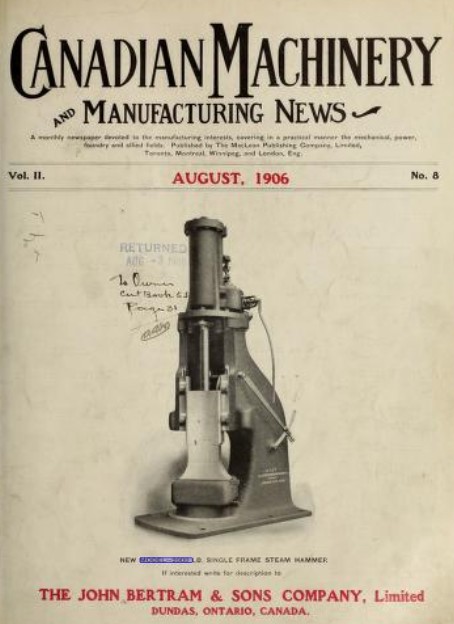
Slamming down with immense force, the steam hammer turned searing hot steel and iron into exacting pieces of bridgework, axles, ship components, and locomotive parts. The machine shaped heavy metal with the ease of a colossus, forging that made lesser equipment wither in fear. The first massive drop hammer was developed by an English engineer in 1839. The technology spread quickly and an ocean away, a company in Ontario launched into steam hammer production, revolutionizing heavy metalworking in the province through the power of steam.
Engineers James Nasmyth and François Bourdon are separately recognized for the development of the first steam hammer in the 1800s. Nasmyth’s intention was forging an enormous steamship paddle in Great Britain, according to Science Museum Group Collection in “Nasmyth’s Steam Hammer.” Better at self-promotion than his competitors, Nasmyth claimed credit, frequently “attending the start-up of a new hammer, or showing that it was so controllable that it could merely crack the top of an egg placed in a wine glass.” Nasmyth was awarded a British patent in June 1842.
Emigrating from Scotland in 1852, John Bertram was hired to work at McKechnie and McDonald’s machine shop at Dundas, Ontario. The firm’s workers manufactured large-scale equipment for civil engineering projects. Bertram partnered with McKechnie in Canada Tool Works in 1863, and on McKechnie’s retirement became full owner in 1886. With his adult children also employed at the firm, the industrialist changed the business name to John Bertram & Sons Company Ltd.
The factory produced a long list of industrial and railway machinery: “planers, shapers, drills, milling machines, lathes of various description, bolt cutters, punchers, shears, slotting machines, plate bending rolls,” and more, adding, “steam hammers, radial drills as well as special machine tools for the locomotive industry,” said Dundas Museum. A nearby mill race supplied water to power the factory, and “in 1889 John had a steam boiler and an 80 hp Wheelock steam engine installed.”
During WW1, the firm built equipment to manufacture armaments. Bertram & Sons advanced into producing large-scale machinery, including specialty equipment for mining and hydro-electric projects. The business also manufactured enormous pieces of machinery for their own use—one particular steam hammer was used for close to sixty years.
On display outside the entrance of Dundas Museum and Archives, the green Bertram steam hammer was produced in about 1939. The steam hammer was “designed to shape large pieces of iron just as a blacksmith’s hammer can shape a red-hot ingot,” noted the Museum/ “The steam-driven piston exerted tremendous pressure on the malleable metal.” The mighty smashing hammer “had to rest on a special shock-absorbing pad to prevent it from shattering the concrete floor of the factory.”
Working with the steam hammer was a perilous assignment. The heavy, extremely hot material to be forged was suspended and held in position with chains, and guided by gloved worker hands holding tongs, described Dundas Museum. “Eventually this system was replaced with a much safer hydraulic arm.”
Through the exceptional force of steam, “the central hammer piston was driven upwards by injecting high-pressure steam into the cylinder’s base,” produced by a nearby boiler, stated How It Works Daily. The workers positioned the metal to be shaped on a durable iron bed underneath the raised hammer. “The steam at the bottom of the cylinder was then ejected rapidly via a condenser, creating a vacuum that, combined with gravity, caused the hammer to drop quickly onto the metal.” The drop speed could be increased “by injecting high-pressure steam into the top of cylinder at the same time.”
The steam hammer could rapidly produce metal components and parts for countless industrial purposes. However, productivity was tempered by the treacherous conditions created by the machinery.
Moving the searing-hot metal into position with special gloves risked burn injuries; crush injuries occurred when human body parts were not clear of the plunging hammer. As well, transferring the hefty steam hammer to a new location presented a threat. On September 15, 1930, thirty-year-old blacksmith shop machinist Melville Knapp received fatal injuries when a steam hammer fell on him at the Canadian Locomotive Company at Kingston, Ontario. “The machine was being moved by a rope, which broke,” said Kingston Workers History Project.
The steam hammer on display at Dundas Museum was purchased second-hand by Stelco in Hamilton in 1954. The machine forged metal “until the mid-1990s, when it was replaced by more advanced electronic machinery,” noted the Museum.
Occasionally still powered by steam, modern heavy steam hammers are now operated by pneumatics and hydraulics for industrial forging. The powerful hammers are efficient pile drivers, utilized for high-rise building construction, bridges, and marine purposes.
The invention of steam hammers satisfied critical construction requirements. While manufacturing with steam hammers in the early 20th century could be precarious, the provincial government now enforces strict safety regulations.
Susanna McLeod is a Kingston-based writer specializing in Canadian history.

