


Susanna McLeod
Special to Canadian Design and Construction Report
Viscous, or light and free-flowing, crude oil remains an essential factor in the construction industry. Refined and processed, oil is transformed into fuel, machine lubricants, plastic components for tools and machinery, and so much more. Oil discoveries in southern Ontario in the mid-1800s signalled the start of new resources. Surveyor John Henry Fairbank (1831-1914) took the lead as inventor, financier, and politician.
Mining opportunities drew avid entrepreneurs. Charles Nelson Tripp established the International Mining and Manufacturing Company in 1851 to explor “the asphalt beds and later the oil springs in Lambton County, Ont., for manufacturing oils, naphtha, paints, and varnishes,” said Mark Lowey in “Drilling into Canada’s Petroleum Industry” (Chemical Institute of Canada, May 2017).
In 1858, James Miller Williams from Hamilton, Ontario drilled a water well at Black Creek but instead found light conventional crude oil. “The discovery became North America’s first oil well and the area was renamed Oil Springs,” Lowey said. Williams was inspired by oil that would affordably illuminate the dark nights.
Excitement bubbled throughout the community. Describing the find as “a beautiful burning oil,” a Sarnia Observer newspaper columnist wrote in December 1858 that “the illuminating properties are so great that an ordinary sized lamp giving a light equal to six or eight candles, can be kept burning at the rate of one-quarter cent per hour,” said Patricia McGee in The Story of Fairbank Oil (Words Unlimited Ink, 2003).
In 1858, Fairbank came to Ontario, hired to survey a land parcel in the region. Born at Rouse’s Point, New York in 1831, John Henry Fairbank was an innovator throughout his life. Inspired by the petrochemical finds, Fairbank purchased land in Lambton County. Cobbling a shack together, he began his quest for oil, while “traveling between London and St. Thomas, Ontario selling machine lubricating oil,” noted Lambton County Museums (LCM) in “Inventor of the jerker-line system.”
Exporting oil in barrels by vessels on Lake Saint Clair, “Fairbank joined with 300 other oilmen to form the Canada Oil Association of Oil Springs,” said LCM. The goal was to “control fluctuating oil prices.” Fairbank noticed that rig machinery was inefficient and expensive to operate. He had a plan.
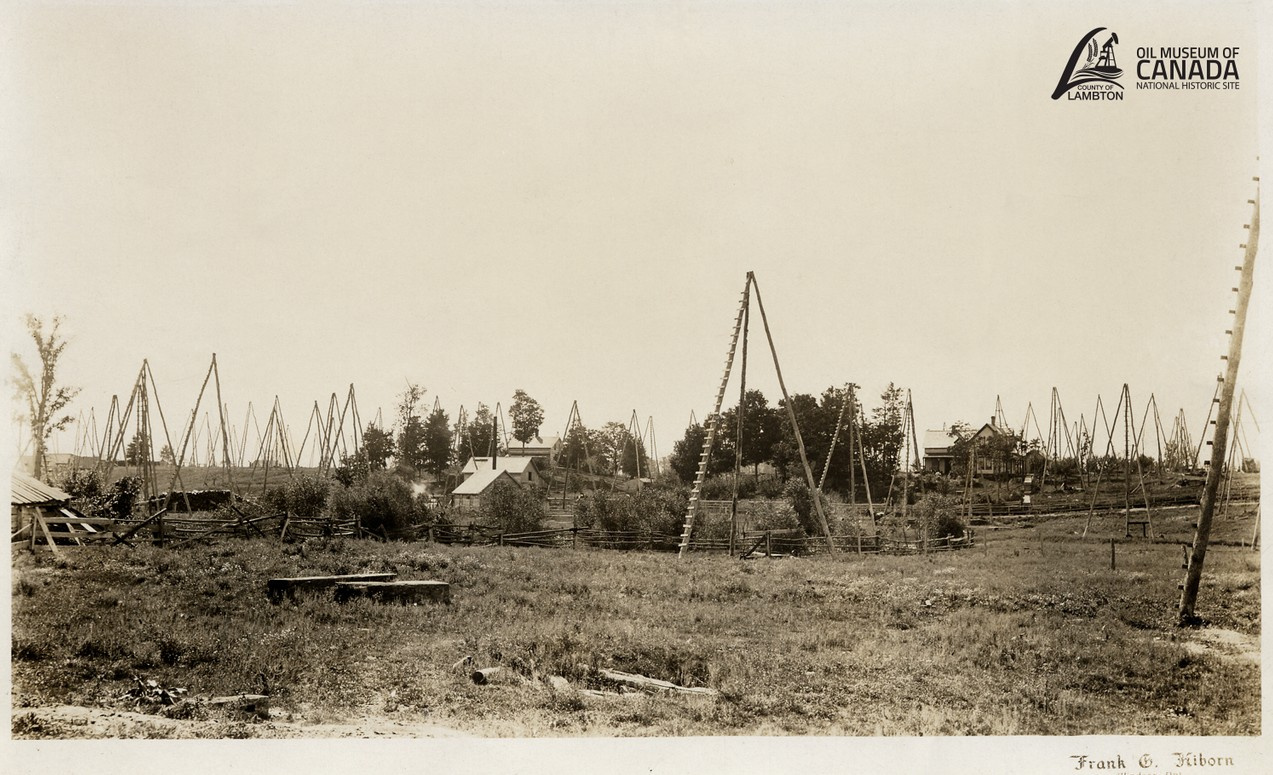
Manually operating a drilling rig was an exercise in utter exhaustion. Armed with shovels, men dug down 15 meters or more through clay. Loaded with earth, buckets were tugged to the surface by pulleys. Transferred to carts, the heavy loads were hauled away by horses. Preventing collapse, the wells were lined with wood, “then, the well had to be fitted with a long, complicated series of pipes, casings and finally, a pump,” stated McGee.
The truly arduous work was still ahead. Each oil well functioned separately. Operating a pump by steam engine was costly, especially if the well did not produce. Owners frequently chose the “spring pole method” instead. Using nearby poles with good bounce cut from Black Ash trees, an energetic man “repeatedly jumped or ‘tramped’ on the treadle” to pump the oil, said McGee. Drilling a test hole at the centre of a lot about a half-acre in size, the pioneer decided “if it produced oil, they would go on to dig four more wells, one in each corner of the lot.” Five wells, five times the sweat.
Devising a time- and energy-saving system, Fairbank dramatically cut the need for exhausting labour. The oilman’s invention in 1863 could power 20 or more rigs at once, sharing the power produced by one steam engine. Connecting to each well, “poles ran parallel to the ground and about a foot above it,” said McGee. “Because it ‘jerked’ as it went back and forth it became known as the ‘jerker system.’”
The jerker-line system was adopted universally, and modernized over the century. Although groundbreaking, Fairbank did not achieve financial gains for his invention—he did not know he could patent his jerker-line. No matter. Fairbank was a wealthy oilman, participating in philanthropy and numerous other industries.
Joining with partners, Fairbank was a merchant and a lumber trader. He had interests real estate sales, and in 1869 with a partner, he “set up Petrolia’s first bank, hauling a building from Oil Springs to Petrolia,” mentioned LCM. Establishing Home Oil Company, Fairbank was also fire chief, and held interests in railways. Politics enticed Fairbank; he was a local councillor, then elected as Federal Liberal member for Lambton East from 1882-1887. In the late 1880s, Fairbank constructed Sunnyside, a 22-room brick mansion for his family at Petrolia. (Extant but abandoned.)
Durable, efficient, and cost-effective, materials derived from oil are used throughout the construction industry. In 1925, Fairbank Oil Fields at Oil Springs was named a National Historic Site. Continuing to produce 24,000 barrels of oil annually, Fairbank is recognized as the oldest continuously operating oil company in Canada. Visit FairbankOil.com for museum information, and images.
Susanna McLeod is a Kingston-based writer specializing in Canadian history.

