


Canadian and Design Construction writer
A resurgence of institutional capital and a stabilizing industrial sector are signaling the start of a new capital cycle for the Canadian commercial real estate (CRE) market, despite ongoing headwinds from international trade and shifts in public sector employment.
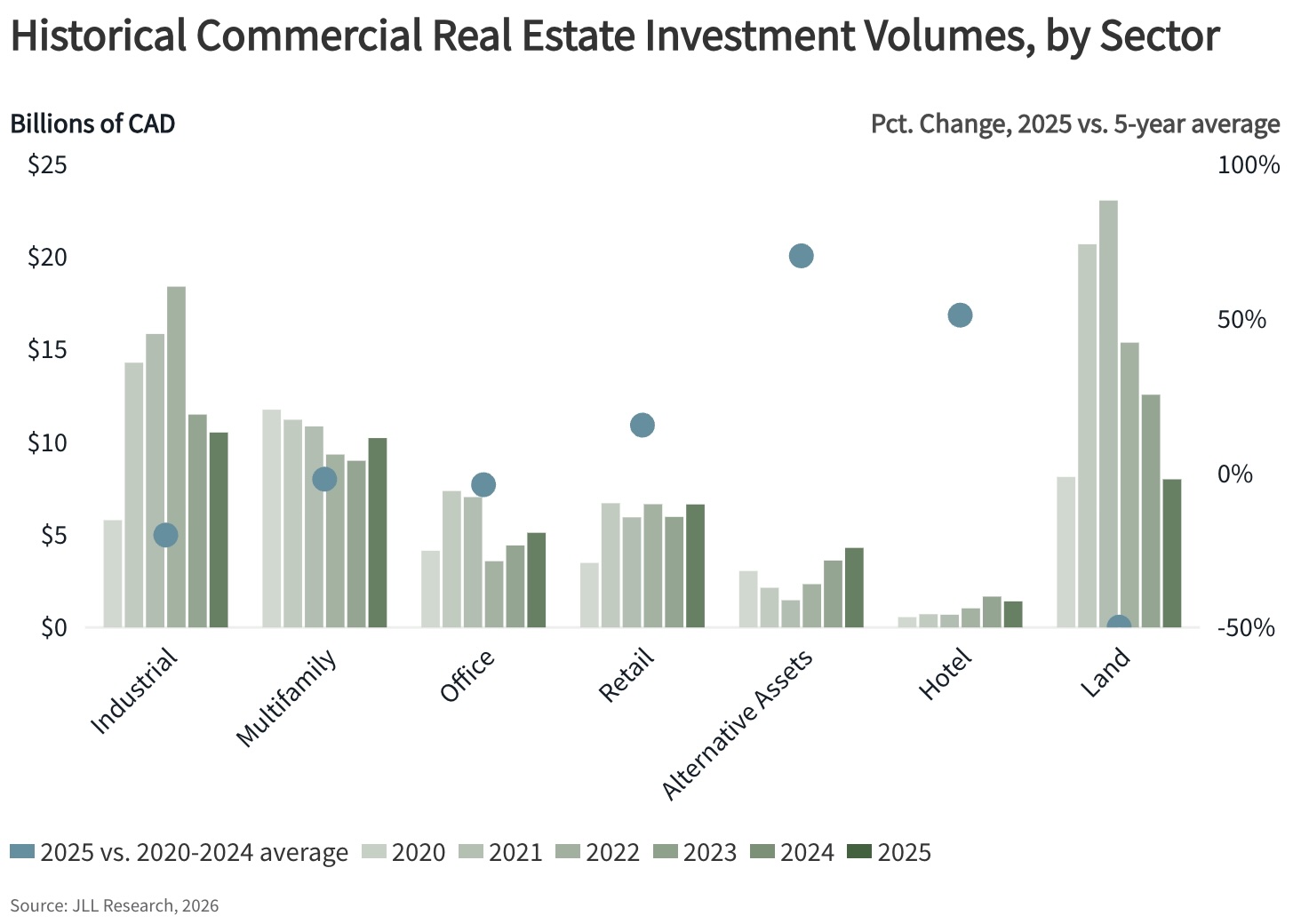
According to the Canadian Commercial Real Estate Outlook, 2026 recently released by JLL, the market is outperforming expectations following a year of transition. While total investment volumes finished 2025 at $46.2 billion—a 5% year-over-year decline and 29% below the 2022 peak—the report highlights a pivotal “return of institutional capital” as a defining storyline for the year.
Pension funds, REITs, private equity, and foreign investors deployed nearly $15 billion in 2025, accounting for approximately one-third of the total market. JLL researchers suggest this resurgence reflects a growing consensus that Canada is entering a cycle characterized by stronger fundamentals and improving returns.
For the design and construction sectors, the most significant shift in the landscape is the transformation of the residential pipeline. Data from the Canada Mortgage and Housing Corporation (CMHC) cited in the report reveals that 2025 was the first year in which purpose-built rental units under construction outnumbered condos or single-family homes.
“The private and public sectors are responding to the housing shortage,” the report notes, adding that booming supply, paired with plateauing population growth, is beginning to stabilize apartment rents across the country.
However, the outlook for other sectors suggests a tightening supply of new projects. In the office sector, only 3 million sq. ft. is scheduled for delivery nationally between 2027 and 2029. JLL predicts this supply drought will lead to falling vacancy rates as leasing activity—which reached its highest annual total in 2025 since 2018—continues to accelerate.
Industrial: After 12 consecutive quarters of vacancy increases, the industrial sector reached a potential inflection point in Q4 2025, with vacancy plateauing at 5.2%. While U.S. tariffs introduced in late 2024 have impacted manufacturing-heavy provinces like Ontario and Quebec, JLL expects industrial vacancy to fall and rents to rise in 2026 as new development starts continue to slow.
Office: The “flight-to-quality” trend remains the dominant driver in office design and construction. Downtown Class AA office vacancy has tightened as tenants migrate from older Class B and C assets to amenity-rich, modern spaces. Nationally, the availability rate has declined for six consecutive quarters.
Retail: Retail has proven remarkably resilient, with spending up 4.5% through late 2025. Construction activity in this sector is currently dominated by discount chains and thrift stores, which are expanding rapidly to meet the needs of cost-conscious consumers facing 7.3% food inflation.
Provincial performance has diverged based on economic foundations. Extractive-industry-tied provinces have fared better under current trade conditions than the manufacturing hubs of Central Canada.
Edmonton emerged as the top growth market in 2025, benefiting from interprovincial migration and a record-breaking multifamily investment volume that more than doubled its previous five-year average. Conversely, Ottawa’s job growth faced significant pressure due to public sector headcount reductions under the new federal government.
Looking ahead, JLL remains “cautiously optimistic” regarding a capital markets recovery across all asset classes in 2026. For developers and contractors, the report suggests a shift in focus toward “experience-centric” workplaces and “elastic portfolios” that allow organizations to scale space in response to AI-driven workforce shifts.
“A clearer picture is emerging of how (international trade) is impacting Canada’s economy,” says Scott Figler, national research director at JLL Canada. While tariffs stifled the recovery initially, the report confirms they did not induce the recession many had feared, leaving the construction and design industries on more stable footing entering the new year.

