


Canadian and Design Construction writer
A handful of Canadian cities drove the country’s push to diversify trade away from the United States in 2025, while many others struggled, according to a new report from the Canadian Chamber of Commerce.
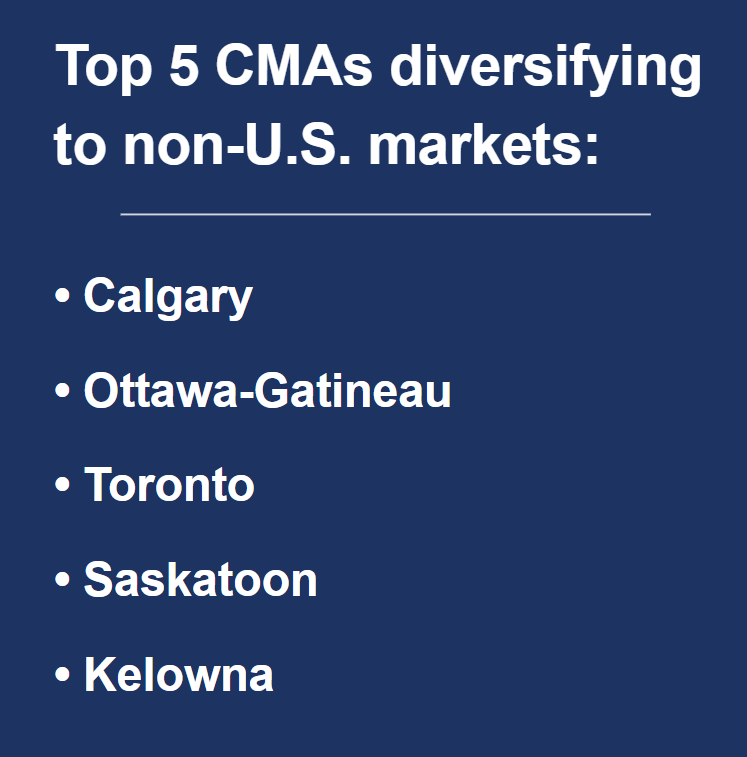
The report shows Calgary, Ottawa-Gatineau, Toronto, Saskatoon and Kelowna, B.C. with the strongest growth in exports to non-U.S. markets last year. Calgary and Ottawa-Gatineau recorded the largest increases in exports outside the U.S. between 2024 and 2025, increasing 65 per cent and 64 per cent.
Toronto recorded a 32.8 per cent increase in non-U.S. exports and Saskatoon posted gains of 32 per cent and Kelowna reported 28.6 per cent growth. Nationally, exports to markets beyond the U.S. were up 16.8 per cent.
“Canada’s trade relationship with the United States will always matter deeply, but this research shows us that resilience increasingly depends on our ability to diversify,” said Candace Laing, President and CEO of the Canadian Chamber of Commerce. “Some Canadian cities are adapting quickly to this era of repeated global economic shocks, while others remain highly exposed to U.S. policy and demand uncertainty. Canada does not just need more trade — it needs more traders.
“The challenge now is ensuring more businesses and communities have the tools, agency and confidence to break out of the ‘domestic comfort trap’ and compete globally by better understanding where demand for Canadian goods and services already exists.”
Findings suggest many Canadian regions have yet to see similar benefits. Manufacturing centres in Ontario continued to face weaker trade performance and limited progress in diversifying export markets.
“Small to medium sized businesses are 99% of all businesses, and their ability to connect globally is a linchpin in our economic diversification strategy,” said Matthew Holmes, Executive Vice President and Chief of Public Policy at the Canadian Chamber of Commerce. “To broaden our capacity to trade, the data shows where there is a growing divide between cities that are successfully expanding into global markets and those that remain heavily dependent on a single trading partner. In today’s environment, diversification is increasingly essential.”
According to the report, “Some cities are successfully expanding into global markets and building more diversified export bases, while others remain more exposed to U.S. demand, trade disruptions and policy uncertainty.”
A previous chamber report released last year identified Calgary, Saint John, N.B., and Windsor, Ont., as the Canadian cities most vulnerable to U.S. tariffs. Other cities, including Victoria and Halifax, were considered less exposed because of stronger trade ties with Asia and Europe.
“A year later, that exposure is seemingly showing up in economic outcomes locally, although it was not an exact match with who we expected could have been worst hit,” the new report said. “As expected, Canadian cities with greater exposure to U.S. trade are experiencing more local economic stress.”
The federal government has set a goal of doubling non-U.S. exports over the next decade. According to the spring economic update, goods and services exports to non-U.S. markets increased by $33 billion in 2025 compared with the previous year.
While exports to non-U.S. markets climbed sharply between 2024 and 2025, much of the increase came from existing exporters expanding into additional markets rather than new companies entering global trade. The number of Canadian businesses exporting beyond the U.S. grew by only six per cent year over year.
“While fewer businesses report taking no action compared to a year ago, relatively few are actively diversifying sales or suppliers outside the U.S.,” the report said. “Instead, firms are more likely to be raising prices, increasing domestic sourcing or delaying expansion plans,” warning that many businesses still appear to expect Canada-U.S. trade conditions to stabilize.
However, the Chamber report says trade conditions are likely to remain volatile and uneven, with companies’ ability to adapt depending heavily on their location, products and dependence on a single export market.

